 Dextool
Dextool price alerts provide free desktop notifications and personal Telegram or email notifications with Standard or Premium access
Last updated:
Dextool price alerts notify you when a selected trading pair reaches a configured price level. DEXTools includes desktop alerts in the Free plan, while Standard adds personal Telegram and email price alerts and Premium includes those Standard features. Choose the channel you can actually receive, then set the pair and price condition. Free Telegram Price Bots provide a separate way to request market information; their availability does not make personal Telegram threshold alerts part of the Free plan.
Desktop fallback when Telegram or email alerts are unavailable
Price alerts connect a selected pair and price condition with an available notification channel. Desktop delivery suits monitoring through a compatible browser. Telegram and email place the reminder in a messaging account or mailbox, subject to Standard or Premium eligibility. Selecting a channel therefore involves both access and a receiving destination. A visible price chart establishes neither an active notification setting nor permission for the browser to display messages.
An unavailable personal Telegram or email option calls for an account-plan check. Free desktop alerts provide a fallback when browser notifications are supported and permitted. Changing account access and changing browser permission address different causes of missing messages. Keep the receiving channel fixed while identifying which requirement is absent.
Pair identity before the price condition
A price condition needs the intended trading pair, because a token name alone can lead to several markets. Pair Explorer provides the selected market's chart, while Pool Info supplies the token contract and pair address. The token contract identifies the asset; the pair address identifies the pool. Keep the network in view alongside those identifiers.
The displayed price unit belongs beside the target value. Read the unit that the alert control presents before entering a threshold. A dollar valuation and a value expressed in the paired asset represent different quantities. A number copied without its unit can describe a different condition from the one intended. Keep the unit attached to the target when interpreting a message, and compare the notification with the same selected market.
Favorites help keep the intended pair accessible. They organize watched markets; the price condition belongs to the alert settings.
Free desktop delivery and browser permissions
Desktop delivery through a browser requires notification support and permission to display messages. The Free plan includes desktop alerts. Plan access and browser permission control different parts of delivery. The plan supplies the feature, while browser permission allows a system notification to appear. A denied or unanswered permission request can prevent that display even when the selected feature is available.
Browser permissions can be changed later. Withdrawing notification permission offers a reversible way to stop browser messages. Permission controls local display; review alert settings separately when you want to change a target or stop monitoring a pair. A blocked browser notification and an incorrectly configured price condition require attention in different settings.
Does Standard already include Telegram and email alerts?
Standard includes personal Telegram and email price alerts, and Premium includes those Standard features. Standard therefore covers the channel requirement when desktop delivery alone is insufficient. Premium adds other benefits, but those benefits form a separate reason to choose it. The channel determines where the reminder appears; the configured price condition determines which market event prompts it. An eligible account still needs its receiving destination configured.
DEXT holdings and monthly access
Standard offers a holding route and a monthly subscription route, which create different commitments for someone seeking personal message delivery. The listed holding requirement is 1,000 DEXT. Standard lists a $19.90 monthly subscription payable in DEXT. The dollar denomination describes the subscription charge. It is separate from the token-count holding threshold.
Holding 1,000 DEXT is different from paying a subscription in DEXT. The holding route concerns the wallet balance used for access; the payment route concerns the subscription charge. Premium lists a 100,000 DEXT holding requirement and includes Standard features. These access terms can change. The account's displayed eligibility and payment terms matter when selecting a plan, particularly if an older explanation quotes different pricing.
The DEXT balances qualify account access. They are separate from the watched pair and the price target entered for its alert.
Telegram Price Bots and personal alerts
A Telegram Price Bot returns requested pair information in a group or channel, while a personal price alert monitors a configured threshold. The Free plan lists Telegram Price Bots separately from the personal Telegram price alerts included with Standard. A bot response to a price request therefore answers a different task from an unsolicited reminder about a target level.
A desktop fallback without a plan purchase
In this hypothetical example, a reader has Free access, a compatible desktop browser, and an unnamed supported pair. Its displayed dollar price is below a chosen target of $0.0748 per token. Personal Telegram alerts are unavailable under that plan, and browser notifications have not yet been permitted. The reader wants a price reminder without buying DEXT or paying a subscription. The target is a chosen alert value, not a current market quote or a recommended trading level.
The Free desktop channel fits this requirement once browser notifications are permitted. After confirming the pair and dollar unit, the reader allows notifications, selects desktop delivery, and creates an above-target alert. The plan controls channel eligibility; the chosen target controls the price condition. No plan upgrade is necessary for desktop access.
The pair price later moves above $0.0748, and the browser displays the matching notification. The received desktop message confirms delivery for that pair and condition without a subscription purchase or swap. Changing the target would alter the monitored price condition without changing the Free plan's channels. The reader can later withdraw browser notification permission without making a token transaction.
Price levels, direction, and alert meaning
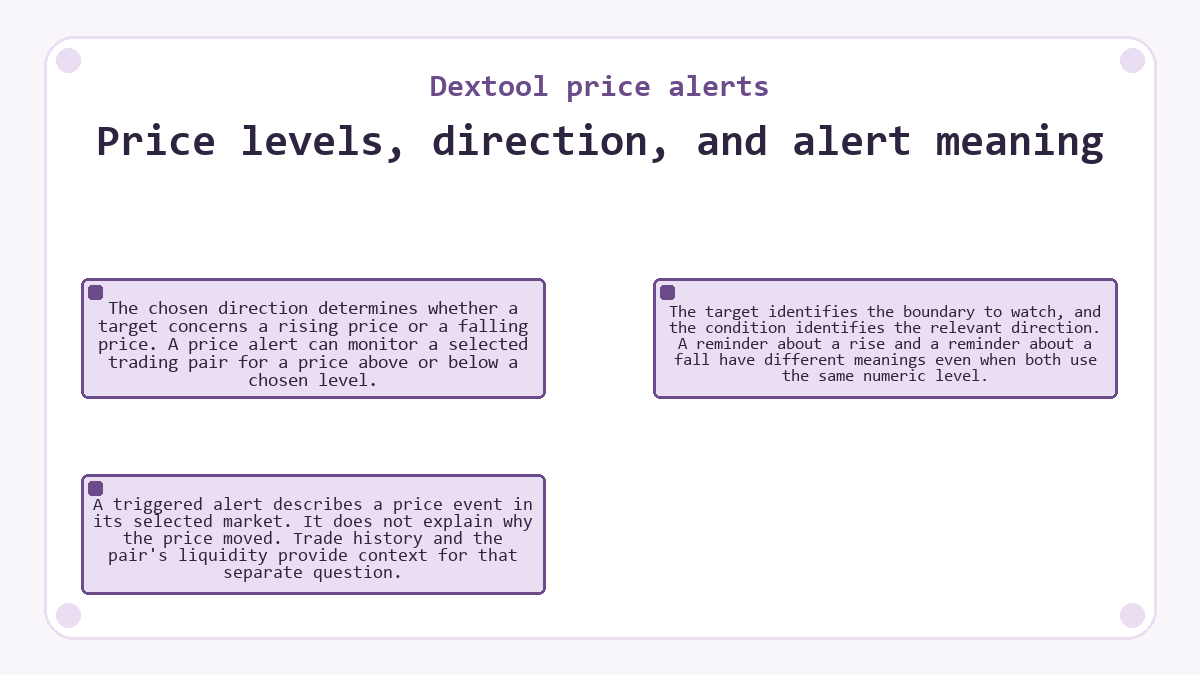
The chosen direction determines whether a target concerns a rising price or a falling price. A price alert can monitor a selected trading pair for a price above or below a chosen level. The target identifies the boundary to watch, and the condition identifies the relevant direction. A reminder about a rise and a reminder about a fall have different meanings even when both use the same numeric level.
A triggered alert describes a price event in its selected market. It does not explain why the price moved. Trade history and the pair's liquidity provide context for that separate question.
Notification timing and swap execution
A price notification reports a monitored market condition, while DEXTswap provides a separate interface for proposing a token swap. Receiving a message does not approve or complete that exchange. The price available when reviewing a trade may differ from the level that prompted the alert. Slippage is the difference between expected and executed trade prices. Notification delivery does not reserve a quote, prevent price movement, or turn the target into an automatic execution instruction.
A late notification can still describe an earlier market event. Before interpreting the message as a price currently available for a swap, compare it with the selected pair's present chart and the proposed trade quote. The quote concerns the contemplated exchange; the alert concerns the monitoring rule.
Receiving accounts and notification visibility
Email and Telegram delivery depend on the configured receiving destination, alongside account eligibility. Inbox filters and muted chat notifications can affect whether an arriving message attracts attention. Notification previews can also expose a watched token or target on a shared screen. Choose a receiving account and display settings that suit that visibility. Browser permission to show a message authorizes local notification display; it does not authorize a token transfer.
Dextool price alerts questions worth asking
Can I monitor a token that I do not hold?
You can monitor a trading pair without owning the token being watched. The alert concerns the selected market and price condition. DEXT holdings can qualify an account for additional notification channels, which is a separate requirement from owning the asset whose price you want to follow.
How does the chart timeframe relate to a price alert?
The chart timeframe describes the period represented by each candle, while a price alert uses a configured price condition. A longer candle can contain both rising and falling prices. Read the alert target separately from the chart interval when interpreting what a notification means.
Could a rising DEXTscore satisfy a price alert?
A higher DEXTscore does not, by itself, satisfy a configured price threshold. DEXTscore combines project and market information into a rating, while the alert condition concerns the selected pair's price. A rating change and a price event are different measurements, even when both appear in Pair Explorer.
Is holder-group membership required for personal Telegram alerts?
Personal Telegram alerts depend on eligible plan access and notification setup, rather than membership in a DEXT holder group. Standard includes the alerts, while holder-group access has its own holding condition. Treat the receiving destination for a personal reminder separately from access to a community chat.
Does a Price Bot cooldown set the interval for my personal alerts?
A Price Bot cooldown regulates repeated requests for charts or market information. It is separate from the price condition used by a personal alert. The cooldown governs how soon another bot request can be made; it does not specify a delivery interval for personal threshold notifications.
When should I use My Positions alongside price alerts?
My Positions is useful when you want to review a saved position's profit or loss alongside a market-price notification. The alert identifies a configured price event. Position performance concerns the recorded position, so a target-price message alone does not provide the same information as the position tracker.